
Appearance
Bridge Overview
The Zink Bridge is a multi-step, operator-managed bridge between Solana and Zink. It records every transfer as a sequence of on-chain state transitions across two tracker accounts, advanced by weighted authority votes until a configurable threshold is met.
Bridge-specific
The protocol centers on five instructions executed in strict order: deposit, ack_deposit, withdraw, ack_withdraw, and cleanup_deposit. Each instruction mutates tracker state on one chain; the full lifecycle spans both.
What the bridge actually does
A user locks tokens on a source chain. Bridge authorities independently observe that deposit, then vote on the destination chain to create a corresponding withdrawal. Once cumulative authority weight meets the configured threshold, the withdrawal becomes executable. A symmetric acknowledgement then finalizes the deposit on the source chain, and a cleanup step refunds overpaid fees or handles rejections.
That means the bridge is:
- on-chain tracked — every deposit and withdrawal lives as an entry inside a
DepositTrackerorWithdrawTrackeraccount, queryable over standard RPC - authority-mediated — a set of weighted signers must independently observe and vote on cross-chain events before anything finalizes
- threshold-finalized — the
Bridgeaccount stores a fixed-pointU0F64threshold (0.0–1.0 of total authority weight); finalization requires cumulative vote weight to meet or exceed that value, with fractional requirements rounded up - operationally real — an off-chain server/crank loop is required infrastructure, not a convenience layer; without it, authority votes never happen and transfers stall indefinitely
Upstream-compatible
Both chains expose familiar Solana-style accounts, transactions, RPC, and signing. Integrators interact with the bridge through ordinary Solana instructions — no custom transport or non-standard RPC methods.
Five-step lifecycle
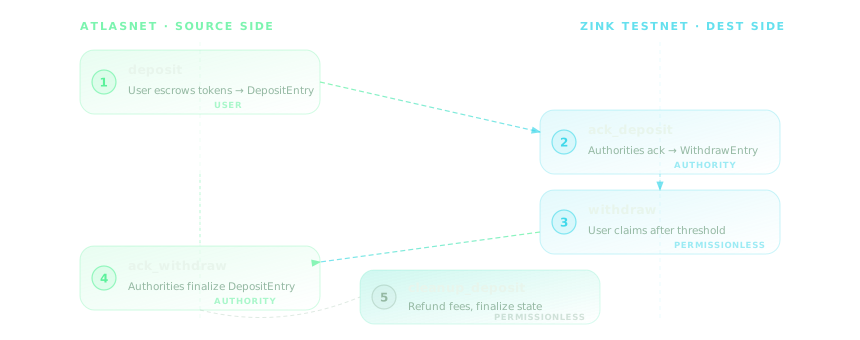
| Step | Instruction | Chain | Permission | Key state change |
|---|---|---|---|---|
| 1 | deposit | Source | User | Creates DepositEntry in Initialized status; escrows tokens into the token-pair vault |
| 2 | ack_deposit | Destination | Authority | Creates/updates WithdrawEntry in Voting; accumulates authority weight toward threshold |
| 3 | withdraw | Destination | Permissionless | Releases or mints tokens to the destination address once WithdrawEntry is Finalized with DepositResult::Confirmed |
| 4 | ack_withdraw | Source | Authority | Votes the destination-side result back onto the DepositEntry; moves it through Voting to Finalized |
| 5 | cleanup_deposit | Source | Permissionless | Refunds excess fees, handles rejected deposits, marks cleanup_completed on the entry |
This sequence is strict. Step 3 cannot execute before step 2 reaches threshold. Step 5 cannot execute before step 4 reaches threshold. Operate and integrate the bridge as a phased protocol, not as an instant asset swap.
Zink recommendation
When documenting or integrating the bridge, preserve the real instruction names and execution phases. Do not collapse them into a fictional "send/receive" abstraction — operators and users both need the phased model to reason about failures and partial completion.
Core state model
The bridge relies on four on-chain account types:
| Account | PDA seeds | Purpose |
|---|---|---|
Bridge | ["bridge", chain_id] | Per-chain-pair configuration: authority set, token pairs, fees, threshold, fee target |
DepositTracker | ["deposit", bridge] | Source-side entry list, entry count, next_finalized_entry cursor, authority vote map |
WithdrawTracker | ["withdraw", bridge] | Destination-side entry list, entry count, cleanup tracker, authority vote map |
AuthProposal | Keypair-based | Governance proposals for configuration changes (add/remove authorities, add/modify/remove token pairs, change threshold) |
See State and Trackers for field-level detail.
Program IDs
| Environment | Program ID |
|---|---|
| Production | BR1DGEaF3Z3ZN9UouYiRLKbK2WWgFmHwUwcZKJfmJSSP |
| Dev / Testnet | BSMryvZi4HYn6ASXrY3xcDwo1sG6pXigaakQMgPMv6gT |
| Localnet | 5Bw3DZTvadDWGJMg7urmZJQwhYoU87fRKcLQ2umT983n |
The static authority address used for program-level operations is AUTHvT1tzXUniLNNPLsQb2wf1fasfXvxi3yDKVfLKbot.
Quick facts
| Parameter | Value |
|---|---|
| Zink Testnet RPC | https://testnet-rpc.z.ink |
| Source chain ID (Atlasnet) | 1001 |
| Destination chain ID (Zink Testnet) | 1002 |
| Bridge program (Devnet) | BSMryvZi4HYn6ASXrY3xcDwo1sG6pXigaakQMgPMv6gT |
See also: RPC Endpoints · Program IDs · Homepage quick facts